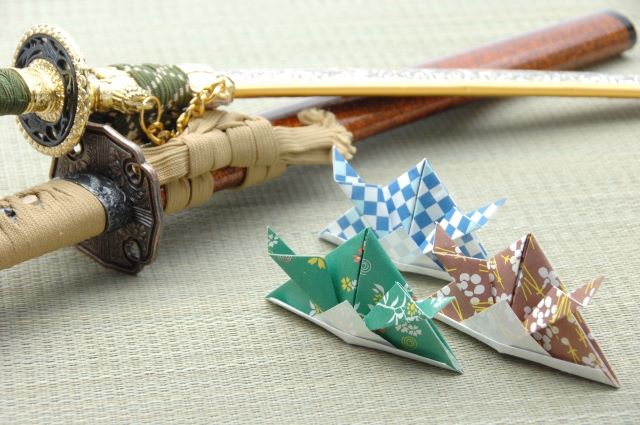
Origin of the Japanese Sword
The Japanese sword, one of the most important aspects of Japanese culture, is now collected not as weapons but as works of art. Today, I would like to discuss the history of Japanese swords and how they came to be what it is today.
The origin of the Japanese sword can be traced back to ancient times. The earliest Japanese swords were influenced by the Chinese and Korean peninsulas but evolved uniquely.
In ancient Japan, swords were treated primarily as sacred objects, used in combat and as part of religious ceremonies and rituals. Japanese swords at the time were called "straight swords," with straight blades and simple blade patterns.
In the Heian period (794-1185), the Japanese swords developed remarkably. During this period, blade patterns and blade shapes became more diverse, and swordsmiths began to pursue both beauty and functionality in their work. Especially in the late Heian period, the "tachi," a sword with a curved blade, appeared.
In the Kamakura period (1185-1333), the demand for Japanese swords increased along with the rise of the samurai class. During this period, the need for more practical and effective swords led to the production of "tachi" swords, which had curved blades similar to straight swords. This became the prototype for later Japanese swords.
In the Muromachi period (1336-1573), the Japanese sword underwent further development. The "kyokutou," which emphasized the curvature of the blade, appeared, forming the basis for the later division of the sword into the "tachi" and "wakizashi" styles. Also, during this period, schools of Japanese swordsmiths evolved, each with their unique techniques and styles.
During the Edo period (1603-1868), Japanese swords were further refined. Demand for swords decreased, and sword-making became a luxury item and art form. Swords were more beautifully decorated, with detailed engravings and metal fittings on the blade and blade design. Many famous swordsmiths emerged, and their works came to be highly valued as works of art.
During the Meiji period (1868-1912), demand for Japanese swords declined rapidly. With the spread of Western firearms, the role of swords gradually shifted from combat to ceremonial and decorative objects. Also in this period, the possession of swords was restricted, and sword-making almost ceased.
Today, Japanese swords are highly valued as works of art with historical and cultural value. Sword production is carried on by modern swordsmiths while preserving traditional techniques. Japanese swords also play an essential role in martial arts, such as kendo and iaido.
The origins of the Japanese sword are not fully understood due to limited concrete evidence and records. However, it is believed that the evolution of the Japanese sword from ancient times to the Middle Ages was shaped by many factors, including changes in local culture, technology, warfare, and religious influences.
sign up for the Japanese-Online Newsletter
__..-・**・-..__..-・**・-.._ あいうえお かきくけこ さしすせそ たちつてと なにぬねの はひふへほ まみむめも やいゆえよ らりるれろ わゐうゑを ん __..-・**・-..__..-・**・-.._
#JapaneseOnline #LearningJapanese #FreeJapaneseLessons #JapaneseVideoLearning #JapaneseAnime #Anime #JapaneseFood #Bloguru